
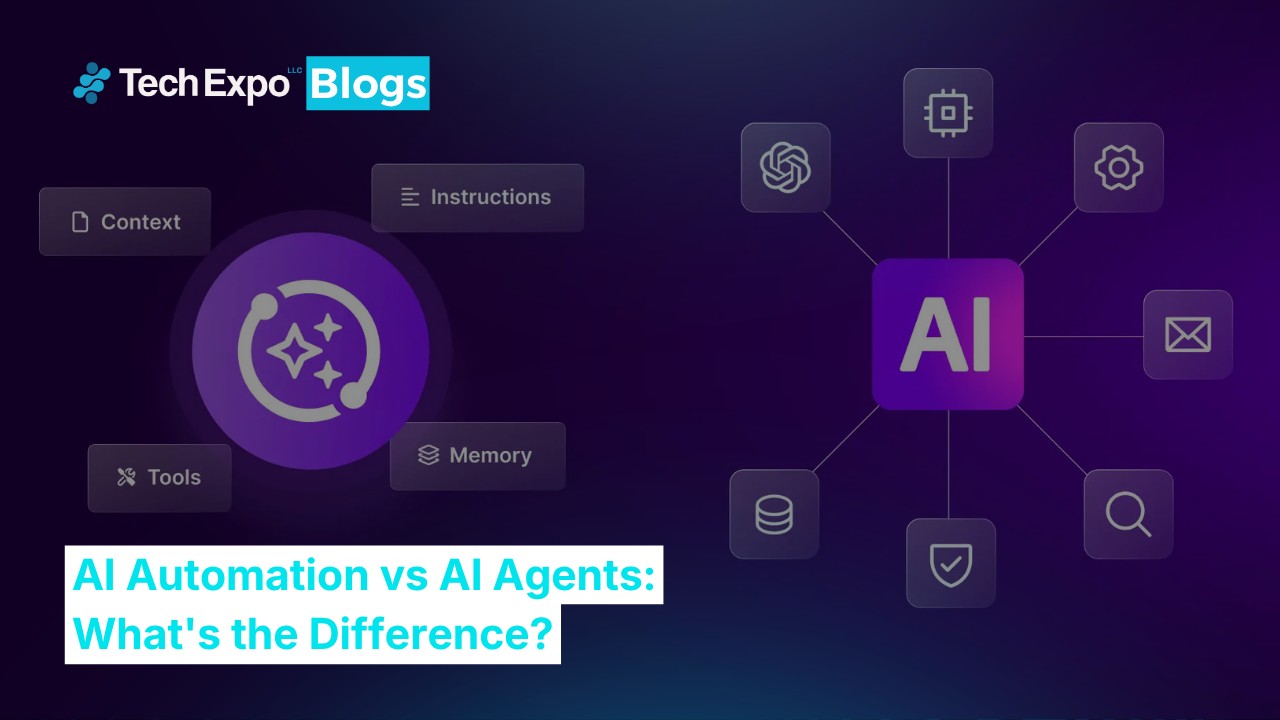
AI is becoming a bigger part of the business world every day. Every day, new AI-powered solutions are emerging and changing the way businesses think about technology, productivity, and the future of work.
As AI becomes more advanced, two terms have become increasingly common in this space: AI Automation and AI Agents. While both can help businesses make better use of AI, they represent two different approaches to getting tasks done.
So, what's the difference between AI Automation and AI Agents, and when should you use one over the other? Let's break it down.
AI Automation
AI Automation refers to using artificial intelligence to automate tasks and workflows that would otherwise require manual effort. It combines AI capabilities with automated processes to handle tasks more efficiently, consistently, and with less human intervention.
Unlike traditional automation, which typically follows fixed rules, AI Automation can use AI to process information, understand inputs, and handle tasks that involve a certain level of variability. This makes it useful for automating business processes that go beyond simple rule-based actions.
It typically starts with a predefined workflow or trigger. When a specific event occurs, the system processes the available information using AI and then performs the actions defined within the workflow.
For example, AI Automation can be used in real-time customer support to analyze incoming messages, identify their intent, and route them to the appropriate team automatically. As each message arrives, the workflow processes it and triggers the next predefined action without requiring an employee to handle every request manually.
Benefits of AI Automation
AI Automation can help businesses reduce the time spent on repetitive tasks and improve the consistency of routine processes. It can also reduce manual errors, increase operational efficiency, and allow employees to focus on tasks that require more human input.
Another advantage is scalability. Once an automated workflow is properly configured, it can handle a larger volume of tasks without requiring the same increase in manual effort.
Limits of AI Automation
It may become a limitation when tasks require flexibility or more complex decision-making.
The main limitation is that it generally depends on a predefined workflow. When a situation falls outside the expected process, the system may require human intervention or additional rules to handle it.
This can make it less suitable for tasks that change frequently or require complex decision-making. In these situations, a more adaptive approach may be needed.
AI Agents
AI Agents are AI-powered systems designed to achieve a specific goal by understanding a task, making decisions, and taking actions with a certain level of autonomy. Rather than simply following a fixed set of instructions, they can determine the next steps based on the situation and the information available to them.
AI Agents can also interact with tools, applications, and external systems to complete tasks. This makes them useful for workflows that require reasoning, decision-making, and the ability to adapt as the task progresses.
It typically starts with a goal rather than a fixed sequence of steps. The agent analyzes the task, considers the available information, and decides what action to take next. It can then use the appropriate tools, evaluate the result, and determine whether another action is needed.
This process can continue until the agent reaches the intended outcome or requires human input. Because the next step can change based on the results it receives, an AI agent can handle workflows that are less predictable and more dynamic.
Benefits of AI Agents
AI Agents are particularly useful for tasks that require flexibility and decision-making. Instead of relying on the same workflow every time, they can adapt to their actions based on the situation and the information they receive.
They can also handle multi-step tasks, work with different tools and systems, and reduce the need for constant human intervention. This makes It useful for businesses looking to automate more complex processes while allowing AI to take a more active role in completing tasks.
Limits of AI Agents
While AI Agents offer more flexibility and autonomy, these capabilities can also introduce some challenges. Because agents can make decisions and change their actions based on the situation, their behavior can be less predictable than a predefined workflow.
They may also require more careful setup, testing, and monitoring to ensure they perform tasks reliably and stay within the intended boundaries. For businesses, this can make AI Agents more complex to manage, especially when they are connected to multiple tools or systems.
After looking at how both approaches work, along with their benefits and limits, the choice ultimately comes down to the type of task you need to handle. AI Automation is a better fit for repetitive, predictable workflows where the steps and outcomes are clearly defined, while AI Agents are more suitable for complex or changing tasks that require reasoning, decision-making, and greater flexibility. In some cases, combining both approaches can be the most effective solution, using automation for structured processes and agents for tasks that require more adaptability.
Ultimately, the right approach should be determined by the nature of the task, the level of flexibility required, and how much decision-making the process involves. Defining these factors clearly can help businesses choose the right AI approach and get the most value from it.