
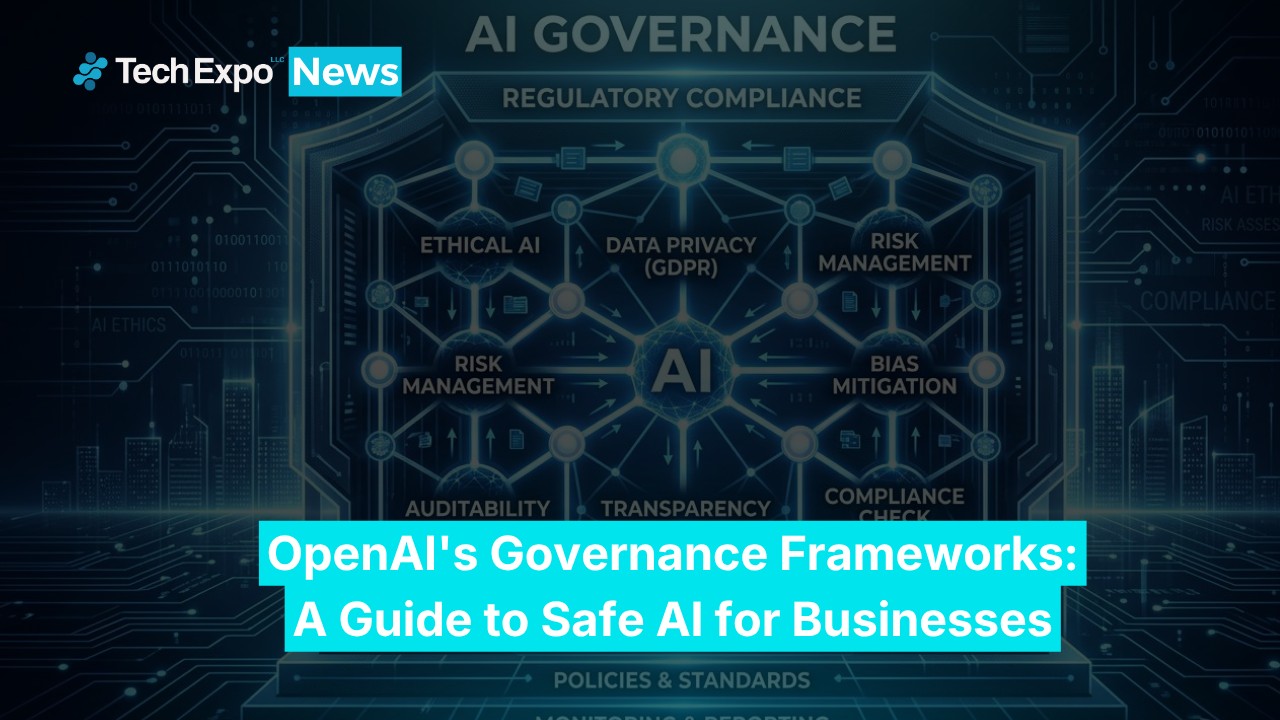
OpenAI's latest governance frameworks give enterprise leaders a clear guide for scaling safe and compliant AI deployments on a global scale.
As large language models (LLMs) become more widely adopted, businesses are increasingly looking for sustainable, commercial-grade AI architectures. To address the risks that come with these advanced systems, OpenAI has introduced its Frontier Governance Framework (FGF), which outlines how it identifies and manages systemic risks.
For businesses using advanced AI models, the FGF offers a practical approach to building secure deployment systems. It also aligns with key regulations, including the EU's General-Purpose AI Code of Practice and California's Transparency in Frontier AI Act (TFAIA).
Understanding the main threat categories is an important first step in turning these regulatory requirements into a business strategy. The framework describes systemic risk as a foreseeable risk that could result in serious harm. This includes situations where a model plays a role in a single incident that leads to more than 50 deaths or $1 billion in property damage.
Although these scenarios are highly unlikely, clearly defining them helps deployment teams to put the right safeguards in place. Setting clear boundaries early allows businesses to dedicate the necessary computing resources and engineering time to ongoing monitoring and third-party audits, keeping applications compliant throughout their lifecycle.
Managing Internal Systems with Tiered Risk Assessments
OpenAI categorizes potential threats across several main categories, including cyber offense, chemical, biological, radiological, and nuclear (CBRN) risks, harmful manipulation, and loss of control.
The categorization system assesses model capabilities using different risk tiers. For example, a tool-augmented model is given a Tier 3 cyber offense rating if it can identify and develop functional zero-day exploits of any severity across many hardened real-world systems without human intervention.
In the CBRN category, Tier 3 models can enable experts to develop highly dangerous threats or independently complete the synthesis of regulated biological threats. Internal security teams can use these risk tiers to set clear limits for their models and determine when stronger oversight is needed.
The framework also addresses harmful manipulation, which involves deliberately influencing or changing human behavior. This can include using AI capabilities to influence people or interfere with elections.
OpenAI recommends managing harmful manipulation through system-level protections, especially ongoing monitoring after deployment. This approach is more important than relying only on evaluations conducted before release. For consumer-facing businesses, real-time content classification can help marketing systems powered by language models maintain objective public messaging.
Loss of control is the term the framework uses for situations where humans can no longer reliably direct or shut down an AI system. At Tier 2, a model in this category can avoid detection across different evaluation methods, including those designed to monitor its reasoning process.
A Tier 3 model is known for performing most complex projects at a level beyond the most expert humans and operating independently for extended periods. It also demonstrates detailed situational awareness and strong stealth capabilities, making it difficult for monitoring systems to reliably determine whether it is avoiding human control, even when its reasoning process is monitored.
Clear risk parameters give businesses using autonomous agents for supply chain logistics or financial trading a defined framework for building reliable fail-safes and keeping humans consistently involved in automated workflows.
Handling Integration Challenges and Information Security Risks
OpenAI follows several international security standards, including ISO 27001, 27017, 27018, and 27701, and also undergoes SOC 2 Type II evaluations. The company protects unreleased model weights through encryption, multi-factor authentication, and strict approval processes involving multiple parties. Employees receive regular security training, while models run in sandboxed environments with external access restricted by default.
Beyond securing the models themselves, enterprises also need to protect the corporate data connected to them. Engineering teams often use Retrieval-Augmented Generation (RAG) and dense vector databases to integrate AI models with proprietary data, but securing these systems against adversarial prompts and data extraction attempts requires additional computing resources.
Security classifiers check every API request before it reaches the vector database, while the retrieved data is also screened before a final response is generated. Connecting modern cloud-based AI governance with older mainframe data requires custom, heavily encrypted middleware. Although this adds engineering complexity, it helps create stable infrastructure that is ready for enterprise use.
Managing Ecosystem Compliance and Incident Response
OpenAI consults external specialists and independent third-party evaluators to keep its risk assessments accurate. These experts test safeguards for models that are nearing a higher risk tier and provide independent feedback to the internal Safety Advisory Group.
Enterprise CDOs can also use external auditing to independently confirm that their local model deployments remain within acceptable risk limits.
External reporting also helps define how often these processes are reviewed within the wider regulatory framework. OpenAI records its mitigation results in a Safety and Security Model Report. Under the EU AI Act, the company commits to assessing whether these reports for its most capable models should be updated every six months.
A report update may be necessary when post-training leads to a significant change in a model’s capabilities or when integrating it with internal systems introduces greater risks. For EU compliance, OpenAI Ireland Limited is responsible, while OpenAI OpCo LLC oversees the company’s obligations under the TFAIA in the US.
Unexpected software issues are handled through OpenAI’s AI Safety Incident Response Plan (AIRP). It outlines the steps for assessing, investigating, and externally reporting severe safety incidents.
Automated monitoring, employee reports, and user feedback can all help identify potential incidents. Response teams then examine the cause, scope, and impact of each issue before taking steps to contain and reduce the risk. Enterprises can adopt a similar approach by creating internal response teams that proactively address unusual API behavior.
Framework updates can be proposed by several OpenAI leaders, such as the Head of Safety Systems, CISO, and General Counsel. At least once every 12 months, the company also carries out a formal Framework Assessment to review changes in regulations, new model capabilities, and evolving industry standards.
Advanced computational models can still play an important role in improving corporate efficiency. Adopting these governance frameworks also helps ensure that internal systems are prepared to meet modern compliance requirements securely.